
Ninety minutes from Zurich, the country changes.
The houses are painted, the fields become smaller and the mountains of the Alpstein start appearing in front of you. In autumn, if you come at the right time, the cattle still come down from the alp decorated with flowers while the villages turn out to watch.
Start with the mountains
Säntis stands above the region at 2,502 metres. On a clear day, the panorama reaches across six countries. Switzerland, Austria, Germany, Liechtenstein, France and Italy.
But I do not automatically take everyone to Säntis.
Sometimes I prefer Hoher Kasten. It is smaller, quieter and gives you a beautiful view across the Alpstein and the Rhine Valley. At the top there is a revolving restaurant that slowly makes a full circle while you eat.
If the weather is good, have lunch there.
There is no reason to hurry back down.
Seealpsee, when you want to walk
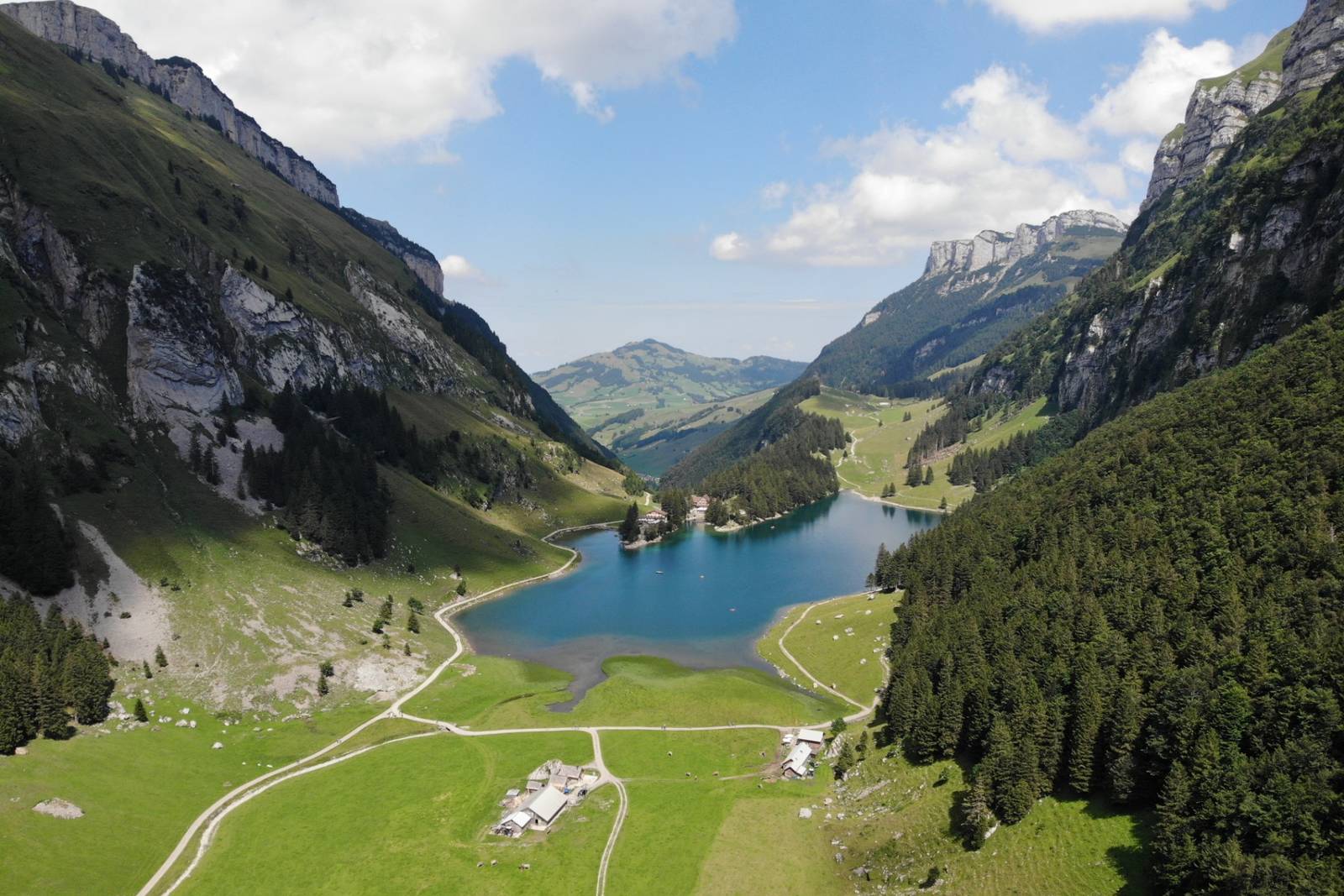
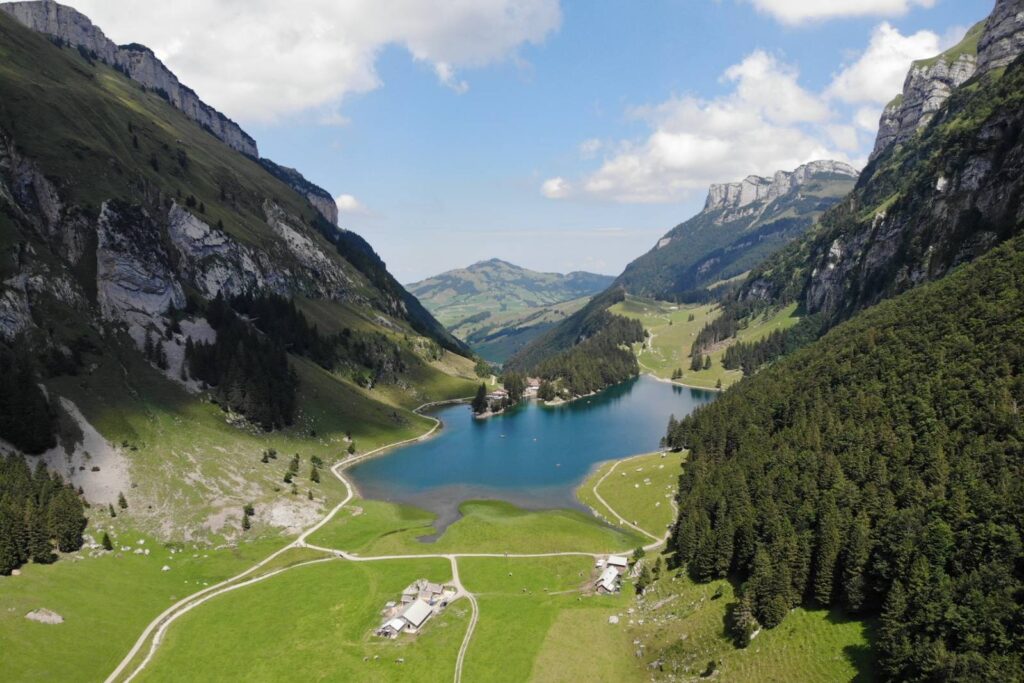
Below the peaks lies Seealpsee, a small mountain lake surrounded by the limestone walls of the Alpstein.
A lot of people have seen photographs of it without knowing where it is.
This is one I recommend when somebody tells me they actually want to walk.
You reach it on foot from Wasserauen, and depending on your fitness and how much of the day you want to spend in the mountains, I can build a longer route around it.
Have something to eat at the lake. Sit outside. Stay longer than planned if the weather is beautiful.
That is Appenzell.
Ebenalp and Wildkirchli
If you want the mountains without a long hike, I might take you up to Ebenalp instead.
From Wasserauen, the cable car takes you high into the Alpstein. From there, you walk down through the rock towards Wildkirchli, where a small chapel sits inside the caves.
Continue a little further and you reach Äscher, built directly against the cliff.
It is one of those places that looks almost impossible the first time you see it.
I would not try to combine every mountain in one day. Säntis, Hoher Kasten and Ebenalp are different experiences.
I choose according to you, the weather and how much you actually want to walk.
Appenzeller Schaukäserei
Then there is the cheese.
In Stein, I like to stop at the Appenzeller Schaukäserei, where you can see how Appenzeller cheese is made and understand a little more about something you have probably eaten many times without knowing much about where it comes from.
You can watch the production, see the cheese cellar and, of course, taste Appenzeller at different stages of maturity.
The exact herbal brine used to give Appenzeller its flavour is still a closely guarded secret.
For families, this is an easy addition to the day. For people who really love food, I can take the experience further and look at smaller local producers and Alpine cheese depending on the season.
Alpenbitter and a beer in Appenzell
Appenzeller Alpenbitter has been produced here since 1902 from a secret recipe of 42 herbs and spices.
The recipe is still kept secret.
Then there is the Locher brewery.
The Locher family has been brewing in Appenzell for generations, and Quöllfrisch is one of those beers that simply belongs here.
You can discover more about the brewery and the brewing tradition, and afterwards have a beer in Appenzell itself.
I like experiences like this because they do not feel like attractions added to a programme.
They belong to the place.
Appenzell itself
The village does not need half a day.
Give me an hour or two.
Walk through the Hauptgasse and look at the painted façades. Notice the old shop signs above the streets. Stop somewhere because it looks interesting rather than because it was on an itinerary.
Then there is Landsgemeindeplatz.
Once a year, eligible voters still gather here for the Landsgemeinde and decide cantonal matters in the open air by raising their hands.
Direct democracy here is not something inside a museum.
It is still happening in the middle of the village.
Come at the right time
Appenzell changes enormously through the year.
Come during the Alpine cattle descents and you may see the herds returning from the mountains, accompanied by farmers in traditional dress and the sound of cowbells.
Come in winter and the Alpstein is another world.
And then there is Silvesterchlausen.
Around New Year, elaborately dressed figures move from house to house through parts of the Appenzellerland, carrying enormous bells and wearing extraordinary handmade headdresses.
It is one of the strangest and most beautiful traditions in Switzerland.
But you do not necessarily need a festival.
Come on a quiet summer day when nothing in particular is happening.
Walk around the village. Go into the mountains. Eat some cheese. Have a Quöllfrisch or Alpenbitter.
Sometimes that is the Appenzell I prefer.
A few places I keep for the right guest
There are small mountain inns where I would rather stop for lunch than book the most obvious restaurant.
There are roads through the Appenzeller countryside that I take simply because the drive is beautiful.
There are Alpine farms and smaller cheese producers that make more sense for some guests than the larger visitor attractions.
And there are walks where the destination is not particularly famous.
That is part of why I like showing Appenzell privately.
Not everything needs a name.
From Zurich and back again
Your private driver collects you at your hotel in Zurich.
The drive is around ninety minutes each way, depending on traffic and where in the region we are going, and I normally plan Appenzell as a full day.
Your private driver takes care of the route. The cable cars, the Schaukäserei, the local experiences, the restaurants and anything else we decide to include are held for you.
But I would never try to fit Säntis, Hoher Kasten, Ebenalp, Seealpsee, cheese, beer and Appenzell village into the same day.
Tell me if you want mountains, hiking, food, traditions, small villages, or simply a side of Switzerland you have not seen before.
Then I choose the day around you.
This is one of the private days we arrange from Zurich. Begin the conversation.